MBNA Website
  • HOME
  • ABOUT US
    • Officers & Working Group Members
    • MBNA Members & Sponsors
    • BECOMING A MEMBER
    • MBNA Meeting Minutes/Videos
    • MBNA Meetings
    • MBNA By-Laws
  • CALENDARS & EVENTS
  • PROJECTS of INTEREST
    • Beachwalk
    • BEACH & WATER QUALITY >
      • SARGASSUM
      • BEACHFRONT CONCESSIONS
      • INDIAN CREEK WATERWAY & CHARTERS
      • TURTLE NESTING
    • Development Working Group
    • Homelessness Working Group
    • TRANSPORTATION WORKING GROUP >
      • COLLINS AVE NORTH PROJECTS
      • Collins South (25th to 41st) Projects
      • Indian Creek Drive
      • Crosswalk to Bayshore Park
      • Julia Tuttle Causeway 195
    • PUBLIC SPACES PROJECTS >
      • MIAMI BEACH PROMENADE
      • 36th Street PARK
      • 46th Street Sand Lot
      • Sidewalk Utility Markings
  • OTHER TOPICS OF INTEREST
    • 2026 Yacht Collection
    • FONTAINEBLEAU HOTEL WATER PARK
    • 41st Street Revitalization
    • NO TO GAMBLING!
  • HOME
  • ABOUT US
    • Officers & Working Group Members
    • MBNA Members & Sponsors
    • BECOMING A MEMBER
    • MBNA Meeting Minutes/Videos
    • MBNA Meetings
    • MBNA By-Laws
  • CALENDARS & EVENTS
  • PROJECTS of INTEREST
    • Beachwalk
    • BEACH & WATER QUALITY >
      • SARGASSUM
      • BEACHFRONT CONCESSIONS
      • INDIAN CREEK WATERWAY & CHARTERS
      • TURTLE NESTING
    • Development Working Group
    • Homelessness Working Group
    • TRANSPORTATION WORKING GROUP >
      • COLLINS AVE NORTH PROJECTS
      • Collins South (25th to 41st) Projects
      • Indian Creek Drive
      • Crosswalk to Bayshore Park
      • Julia Tuttle Causeway 195
    • PUBLIC SPACES PROJECTS >
      • MIAMI BEACH PROMENADE
      • 36th Street PARK
      • 46th Street Sand Lot
      • Sidewalk Utility Markings
  • OTHER TOPICS OF INTEREST
    • 2026 Yacht Collection
    • FONTAINEBLEAU HOTEL WATER PARK
    • 41st Street Revitalization
    • NO TO GAMBLING!

Sargassum

MBNA Beach and Water Quality Working Group Members:
  • Chair: Oscar Vazquez
  • Projects include:  Sargassum, Beach Re-Nourishment, Beach Concessions​ & more

SARGASSUM CONCERNS:
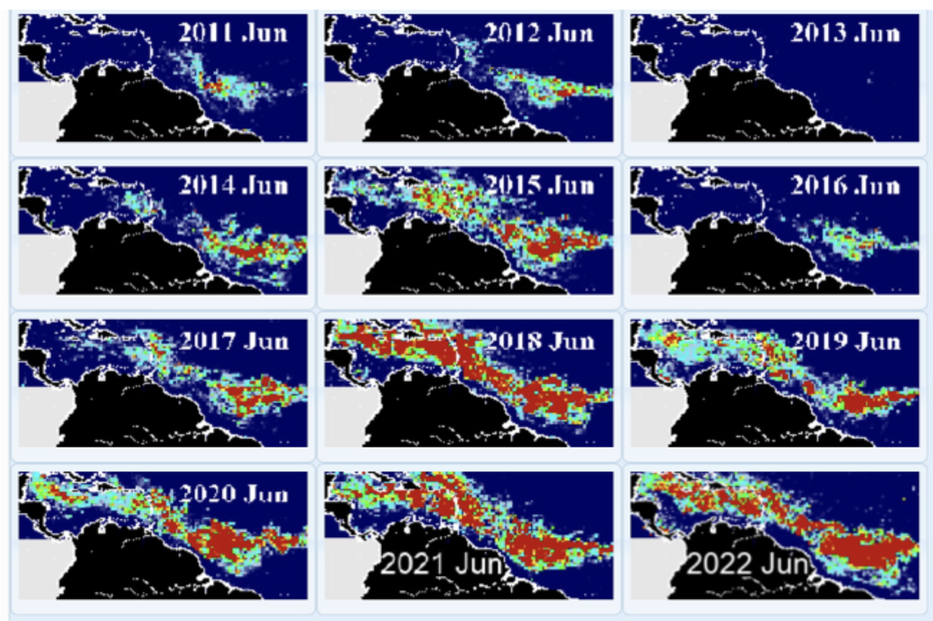
The MBNA is extremely concerned with the ongoing Sargassum that seriously impacts the quality of our beaches.  Sargassum arriving in the Mid Beach area has been increasing since 2011. 

​Already under attack from erosion and rising seas, South Florida beaches have been facing the invasion of Sargassum seaweed.  Washing ashore in increasingly alarming amounts, Sargassum is coating coastlines over much of the state.   

Although we understand that many scientists feel that Sargassum is beneficial for the environment; (see paragraph below), the MBNA is extremely concerned with its impact on our community, including our residents and our tourists, and will work vigorously to have it contained and properly removed from our shorelines.

“Sargassum is a good thing,” Dr. Brian Lapointe of Florida Atlantic University's Harbor Branch Oceanographic Institute said. “It’s fish factory when it’s offshore, but when it comes ashore in excessive amounts, it becomes problematic.  Lapointe has been monitoring this floating seaweed for decades, using satellites to track the 5,500-mile-long Great Atlantic Sargassum Belt. Stretching from the Gulf of Mexico to West Africa, the Belt is home to more than 20 million tons of Sargassum in this recent bloom. “Since 2011, we have seen this ramping up, up and away," Lapointe said.  
Sargassum in the open water or even on our beaches is nothing new. 

The MBNA is in regular communication with City and County Officials to monitor and stay informed of what is being done to prevent Sargassum from accumulating in our valuable shoreline.

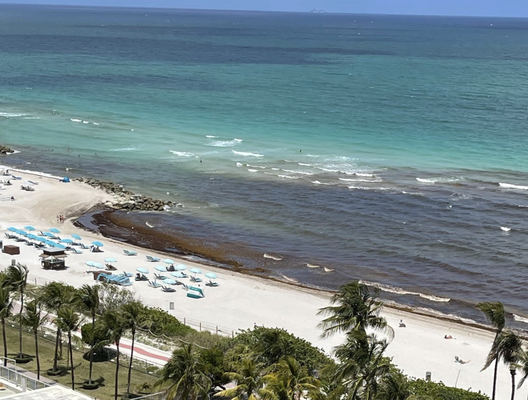
August 8 to 10, 2025 evidence of Sargassum accumulation on our beaches:

SARGASSUM INFORMATION & MEETING NOTES
7-16-25 B&WQ MEETING NOTES
Below is a video update from July 17, 2025.  As anticipated, the cleanup crews were unable to keep pace with the volume of sargassum that came in. Based on current conditions, I would classify the accumulation as reaching emergency levels.

Although I have not yet conducted a drone flyover this morning, I can see from my balcony that the accumulation remains significant. The Mid-Beach hotspot area is effectively unusable for swimmers, and in several sections, the buildup is now at levels of serious concern.

One area I’d like to specifically highlight is in front of the Edition Hotel. There, beach erosion has created a steep slope that now prevents tractors from accessing the area entirely. This is not a new issue, but the severity has clearly worsened and needs immediate attention.

Given the extent of the problem, I hope this can serve as an opportunity to test the County’s capacity to deploy additional equipment and resources promptly. This situation underscores our previous concerns about the limitations of the current operation and the need for a more flexible, scalable response particularly as we move deeper into the season.

Thank you for your continued attention.
Oscar Vazquez, Chair Beach & Water Quality Working Group

July 17, 2025 Email from Oscar Vazquez, Chair
Thanks to all of you that attended yesterday's Beach and Water Quality Working Group call. Today’s field video documents a significant accumulation of sargassum in the Mid-Beach area, particularly near the breakwaters. As the camera approaches this zone, there is a noticeable increase in the depth and density of seaweed, creating a shoreline that is difficult to navigate and visibly overwhelmed.
Key Conditions and Implications
  1. Heavy Accumulation at Breakwaters
    The concentration of sargassum becomes excessive near the breakwater structures. Based on the volume visible in the footage, this accumulation will likely exceed the capacity of current beach cleaning equipment, especially with high tide occurring at 2 PM. Rising water will re-float and redistribute much of the material, further worsening the situation and making removal less efficient.
  2. Collection Began Outside Approved Permit Zone
    Collection activity appears to have started south of the permitted cleanup zone. While this likely reflects an urgent attempt to control the accumulation, it reinforces the ongoing problem with the current permit boundaries. These boundaries no longer match the areas most affected by drift and deposition and must be reevaluated for expansion.
  3. Equipment Efficiency and Haul Time Constraints
    With this level of material on the beach, collection equipment fills rapidly and must make long trips to disposal sites. This reduces the effective working time for each machine and stretches the operational window. The equipment is unable to keep pace with the rate of accumulation during peak conditions, which results in lingering material that decomposes, creating both a public nuisance and a biological hazard.
  4. Turtle Hatchling Risk
    The area in question is also a known turtle nesting zone. The current accumulation creates physical barriers that may prevent hatchlings from reaching the ocean or may trap them in decomposing vegetation. With nests now observed unusually close to the high tide line, even moderate storm activity could result in nest loss.
  5. Breakwater Effects and Reintroduction of Dried Sargassum
    The breakwaters continue to create a harmful feedback loop. As observed in the footage, dried sargassum that has not been removed is being drawn back onto shore during repeated high tides. This leads to the formation of thick, dark mats of decomposing material that render the beach unusable. The appearance and odor are consistent with past observations and are especially concerning during the peak of tourism and nesting season.
Recommendations
  • Expand state and county permit zones to match actual accumulation zones beyond the current hotspot definition
  • Evaluate the long-term impact of breakwaters on seaweed retention and sand erosion with support from the Army Corps of Engineers
  • Improve equipment staging and minimize haul times to increase daily cleanup efficiency
  • Reinforce biological protection zones with increased attention to nest locations and hatchling movement
  • Align seasonal staffing to match observed conditions. There should be zero collection effort after September and operations should not resume until May. Reallocate those resources to the high-volume summer months when they are most needed
These recommendations reflect ongoing concerns shared by residents, member properties and MBNA. The conditions shown in today’s video are a clear example of how changing environmental and physical factors require more adaptive, responsive, and coordinated cleanup strategies.
Best Regards, 
Oscar Vazquez

MIAMI DADE COUNTY INFO ON SARGASSUM
On Wednesday, March 12, 2025, Oscar Vazquez and Alicia Casanova met at City Hall with Commissioner Alex Fernandez, Ron Mumaw, Director Facilities & Fleet Dept., and Elizabeth Miro, Assistant Director, to discuss MBNA's concerns regarding the current schedule for sand raking and removal of Sargassum. , Our goal is to be make the best use of our resources and to prepare for another influx of Sargassum in 2025.  A meeting will be scheduled with the contractors soon to discuss the methodology and strategies as well as the renewal of the Contract. 
Picture

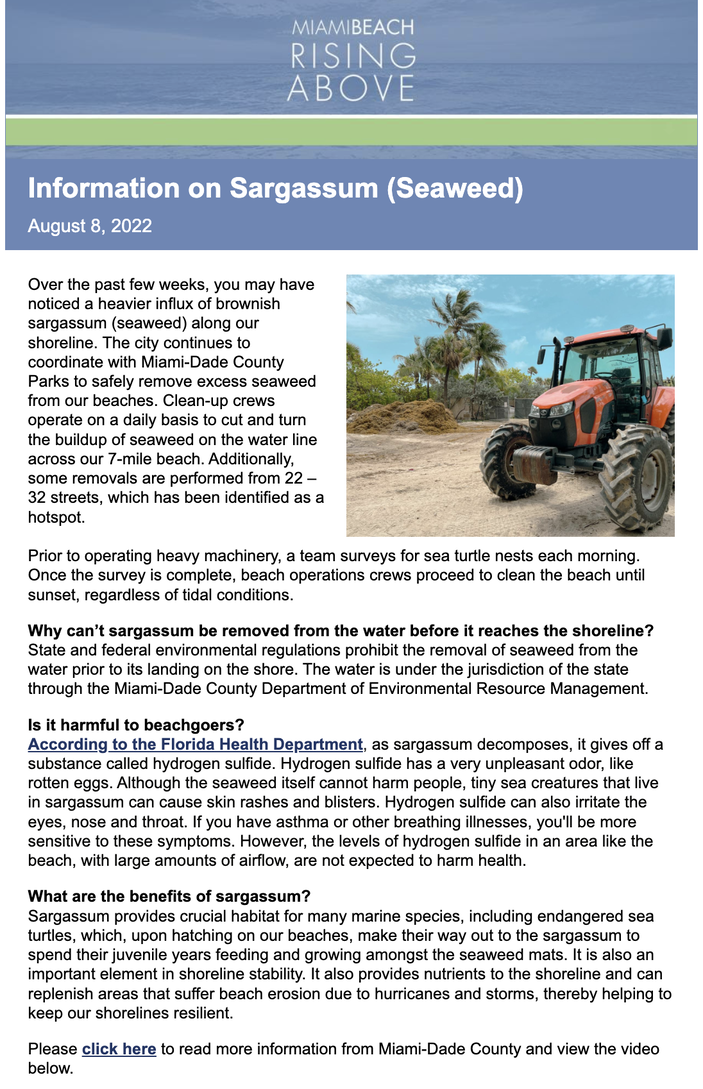
Sargassum, also often referred to as seaweed, is a naturally occurring seaweed that floats freely on the ocean surface and is abundant in the Atlantic Ocean and the Gulf of Mexico. It provides crucial habitat for many marine species, including endangered sea turtles, which, upon hatching on our beaches, make their way out to the sargassum to spend their juvenile years feeding and growing amongst the seaweed mats. It is also an important element in shoreline stability. Sargassum also provides nutrients to the shoreline and can replenish areas that suffer beach erosion due to hurricanes and storms, thereby helping to keep our shorelines resilient.
​
Over the past several years, South Florida and the Caribbean have experienced high levels of sargassum in coastal waters and on local beaches. Excessive amounts of sargassum in populated areas are causing concern worldwide.
Maintaining our beautiful beaches remains a priority for Miami-Dade County Parks, Recreation and Open Spaces Department. During Sargassum season clean-up crews operate on a daily basis to remove the buildup of seaweed on the water line. Below are frequently asked questions on sargassum, for your information.
2024 UPDATES ON SARgASSUM

MBNA's SARGASSUM ACCUMULATION CONCERNS
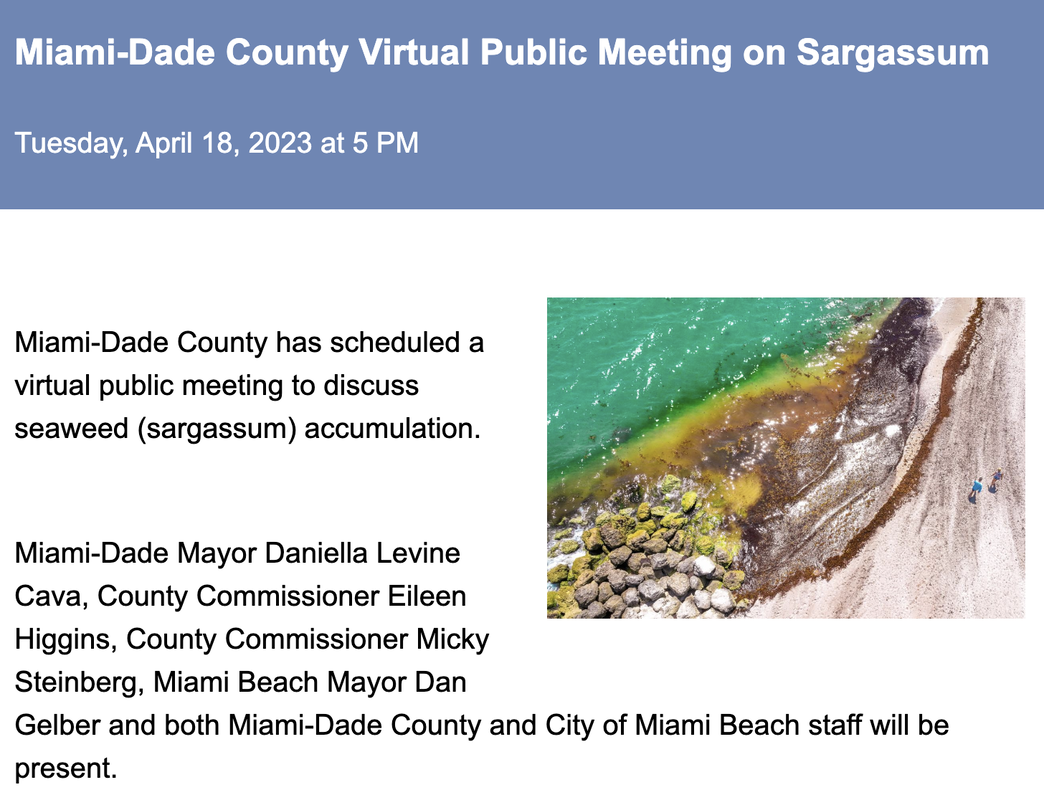
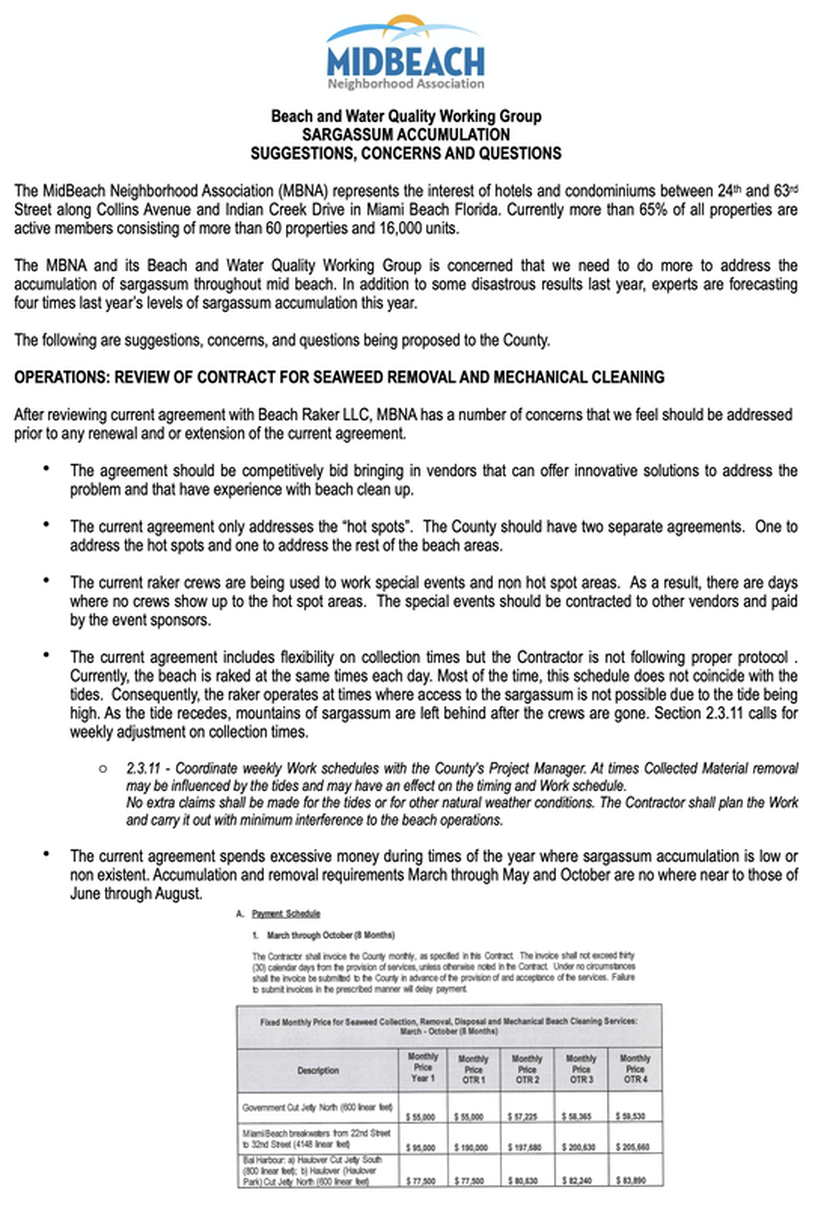
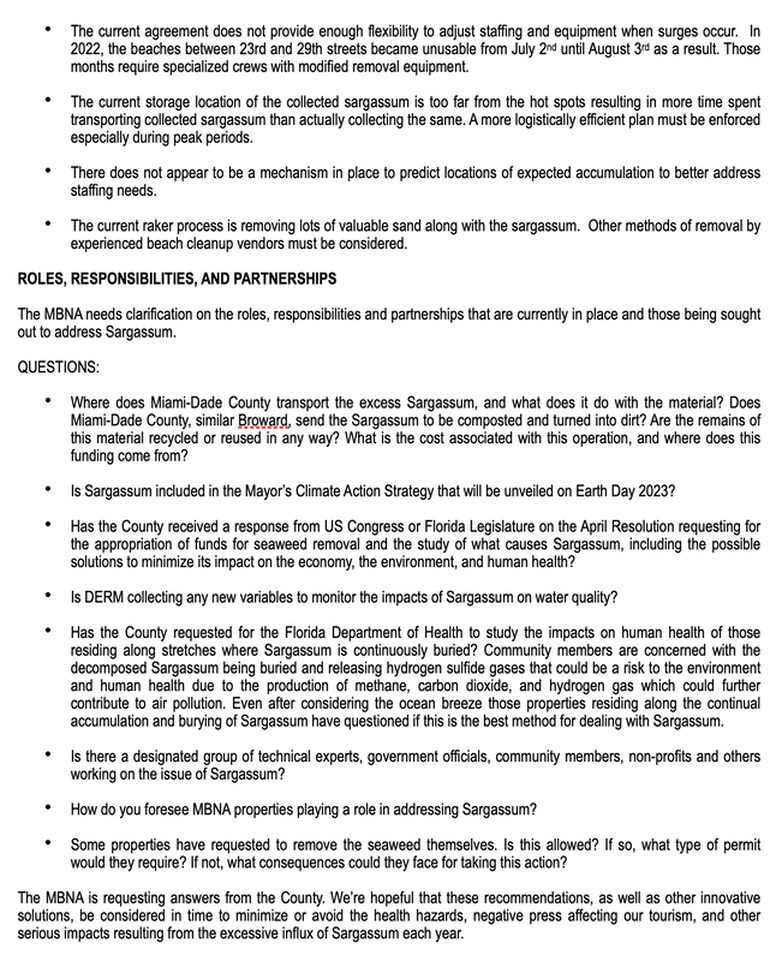
On Tuesday, April 18, 2023, at 5:00 p.m.,  MBNA Members met virtually on Zoom with Miami-Dade Mayor Daniela Levine Cava, City of Miami Beach Mayor Dan Gelber, and other County Officials, to address the current situation regarding the influx of Sargassum in our beaches.  Oscar Vazquez, our Beach & Water Quality Working Group Chair, and Anamarie Ferreira de Melo, our MBNA President, both gave presentations and stated some of our concerns, suggestions and Questions.  The MBNA be following up with both City and County Officials in our efforts to improve this situation.  Below are the MBNA's suggestions, concerns and questions:
Picture

Picture
Picture
SARGASSUM ACCUMULATION CONCERNS, RECOMMENDATIONS & QUESTIONS

Sargassum (Seaweed) 

Picture
Coming soon to Florida beaches: Massive, messy and maybe record mounds of seaweed
Link to article in the Miami Herald - May 14, 2023
BY NICOLAS RIVERO  [email protected]
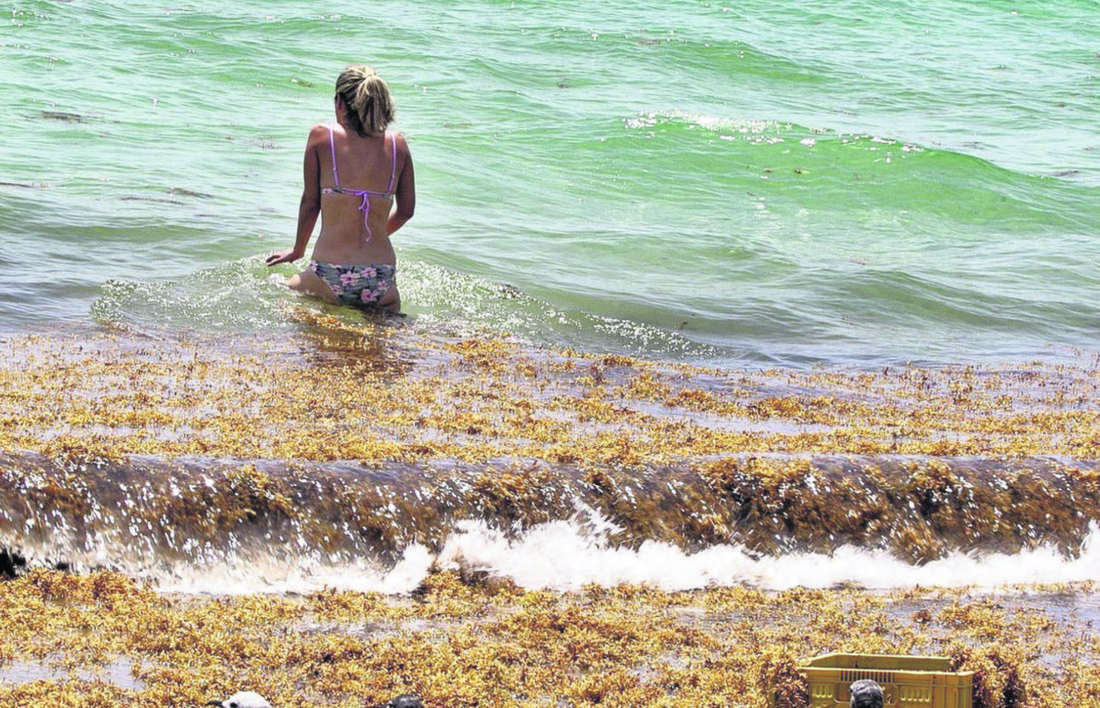
A giant blob of seaweed, spanning 5,000 miles and weighing an estimated 6.1 million tons, threatens to blanket Florida beaches and Caribbean islands with smelly piles of decaying brown goop.
Sargassum — the scientific name for the brown seaweed often found strewn across South Florida beaches — could start piling up in the Florida Keys in the next few days. Scientists expect Miami Beach to become a hot spot later in the sargassum season, which runs from March through October.
This year’s sargassum bloom is shaping up to be one of the biggest ever recorded. Since 2011, a combination of human activity and climate change has created a string of unusually large seaweed blobs. Every year for the past five years has set a new record for the biggest blob ever.

Miami-Dade County has 
identified four seaweed hot spots: beaches in Haulover just north of Haulover Cut; beaches in Bal Harbour just south of Haulover Cut; Miami Beach between 26th Street and 31st Street; and the beaches alongside the South Pointe jetty.
New York Times Article from March 14, 2023:
Picture

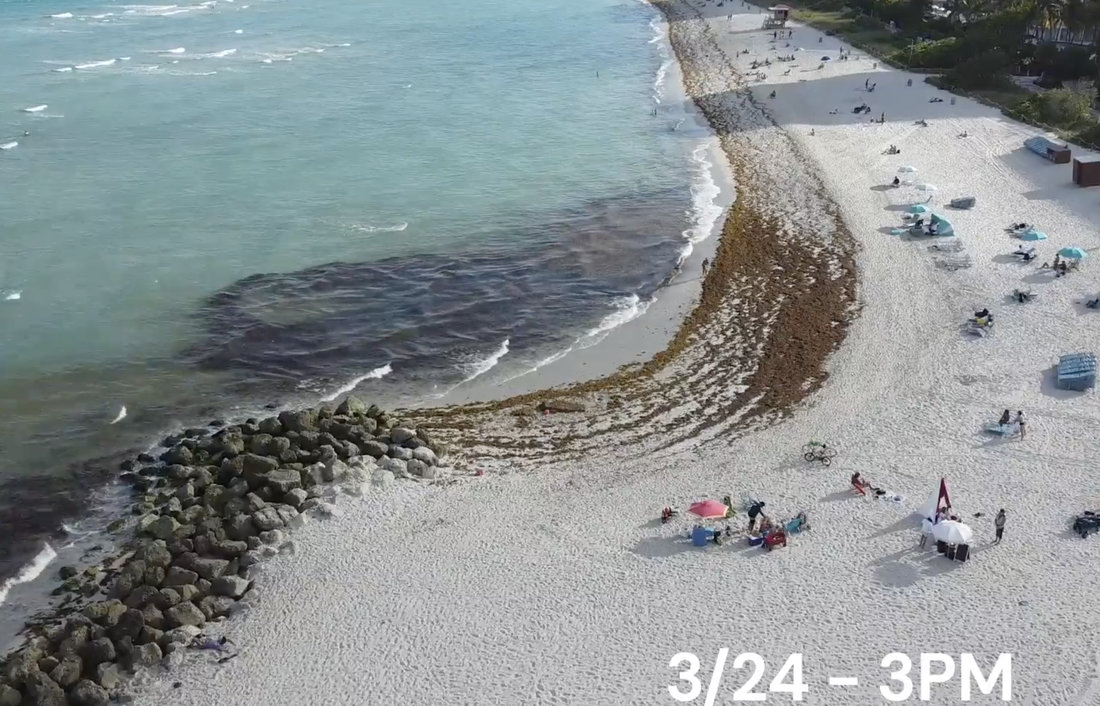
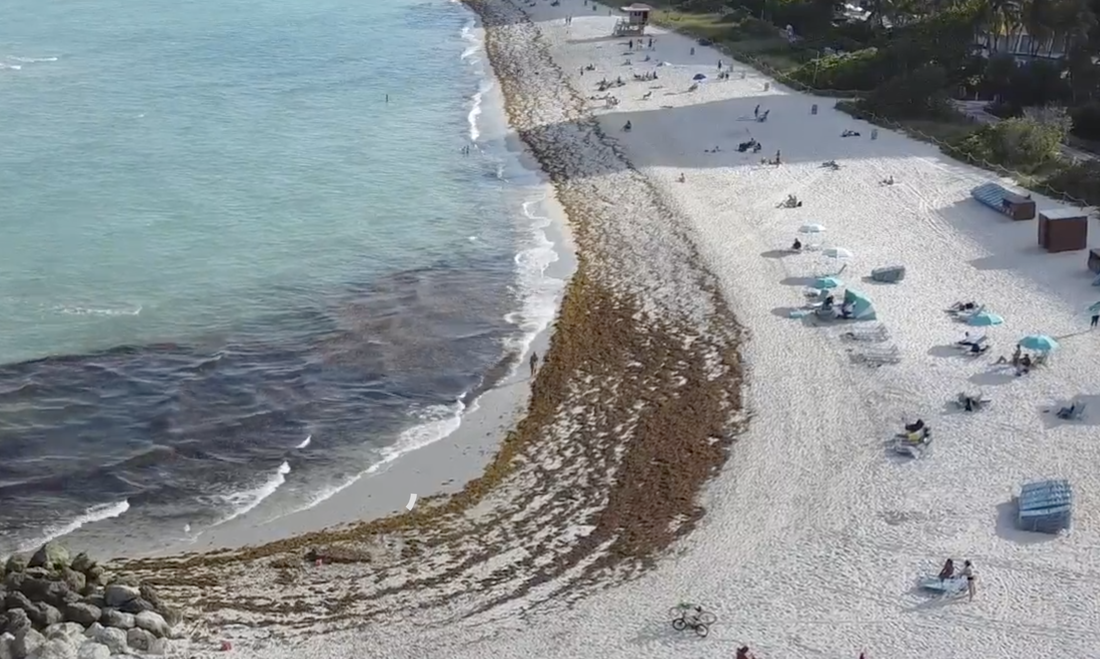
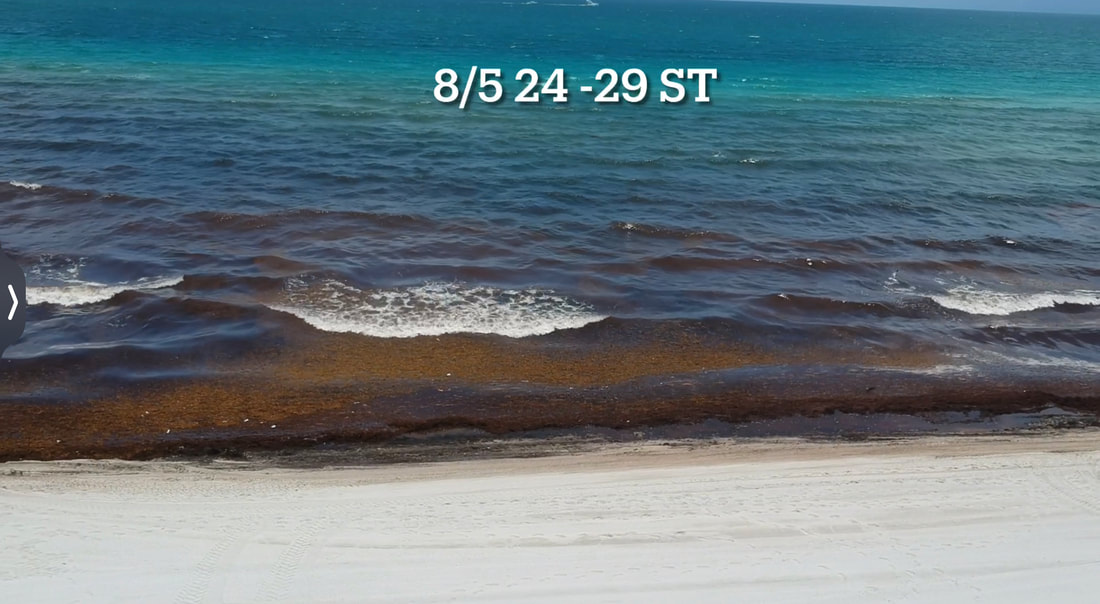
Sargassum on weekend of March 24-26, 2023 from 28th to 29th Street. 
Picture
Picture

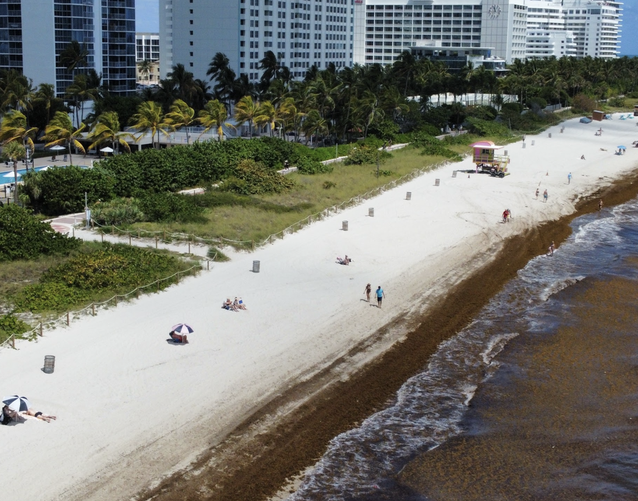
Sargassum on April 5, 2023:
Picture

BEACH CONCESSIONS

Beachfront Concessions. 
​
For detailed information and Applications, please go to our Beachside Concessions page.

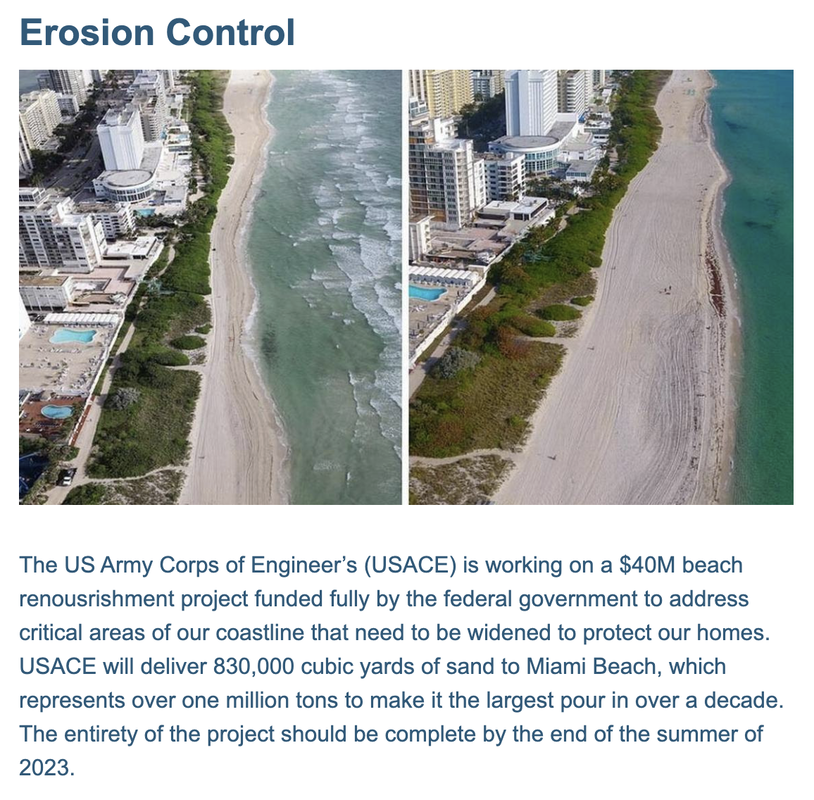
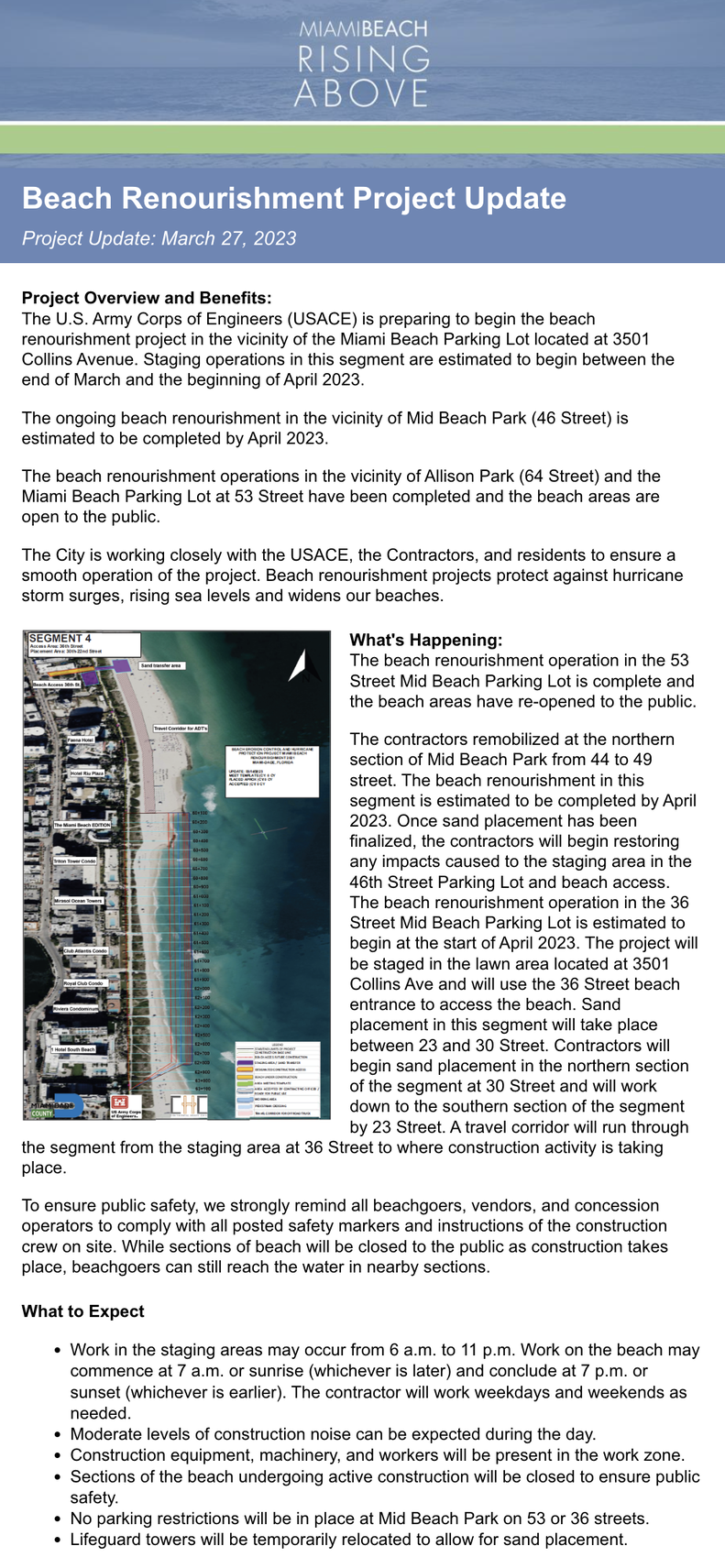
BEACH RE-NOURISHMENT

BEACH RE-NOURISHMENT
Picture


Picture

2-7-23 BEACH RE-NOURISHMENT UPDATE FROM CITY MANAGER
JANUARY, 2023 BEACH RE-NOURISHMENT UPDATE
September 2, 2022 LETTER TO COMMISSION RE BEACH RENOURISHMENT PROGRESS
SEPTEMBER 2, 2022 BEACH RENOURISHMENT PROJECT
July 20, 2022 - MDC VALUABLE INFORMATION RE SARGASSUM
JULY 1, 2022 BEACH RE-NOURISHMENT PROJECT INFO
June, 2022 - CRITICALLY ERODED BEACHES IN FLORIDA - FDEP DOCUMENT
JANUARY 24, 2022 BEACH RENOURISHMENT PROJECT INFO

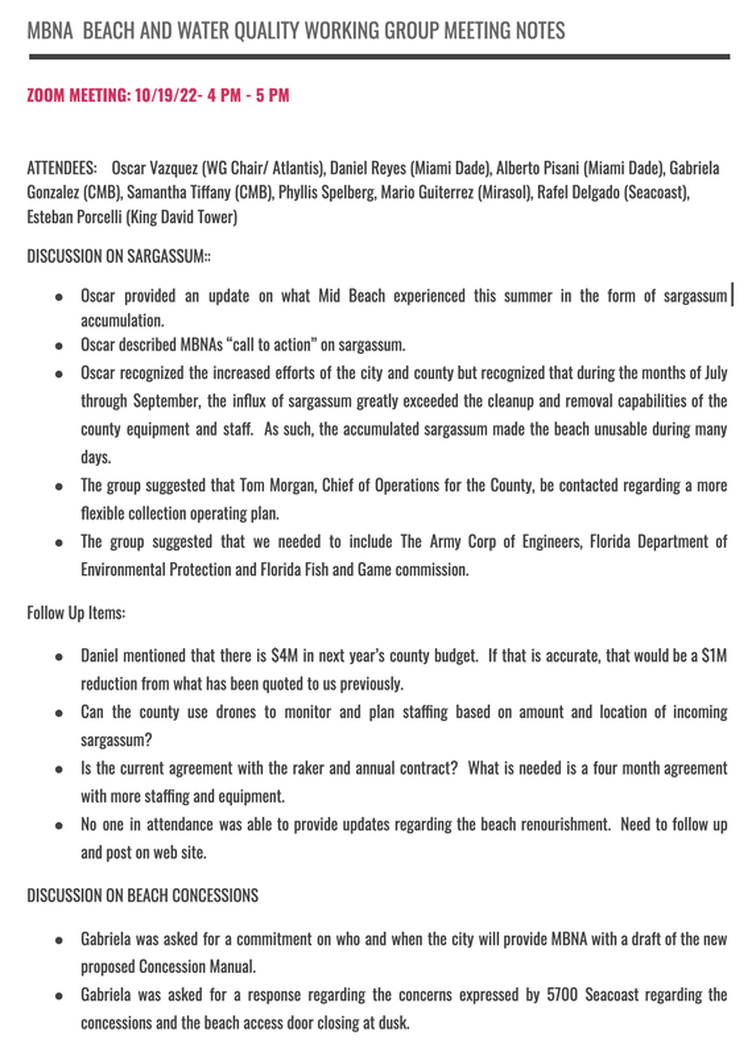
BEACH & WATER QUALITY WORKING GROUP MEETING NOTES (10/19/22)
Picture

MORE INFORMATION ON SARGASSUM:
Picture
BEACH & WATER QUALITY WORKING GROUP MEETING (7/27/22)
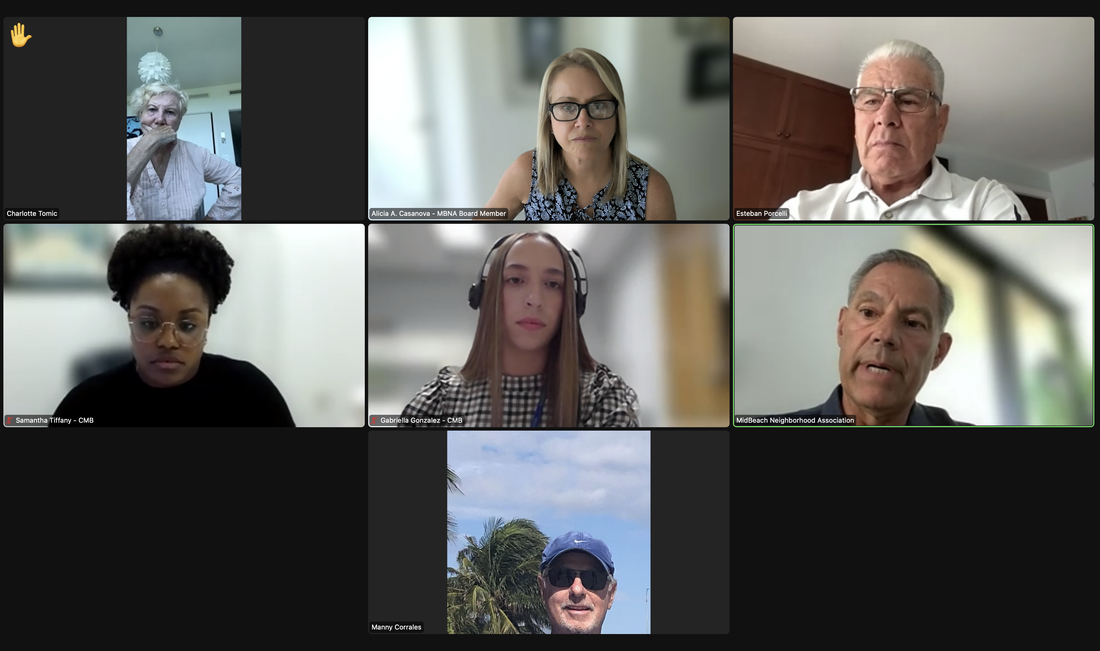
On Wednesday, July 27, 2022, a "Beach & Water Quality Working Group" meeting took place via Zoom.  Oscar Vazquez, our WG Chair, coordinated the meeting in an effort to have the City and State prioritize finding a short term solution to this problem which continues to increase and seriously affect our beaches, especially in the MidBeach areas.  Thank you to Gabriella Gonzalez, the MidBeach Neighborhood Affairs Coordinator, and Samantha Tiffany, the City of Miami Beach's Environmental Resource Manager, for attending the meeting and listening to our concerns.  

Picture

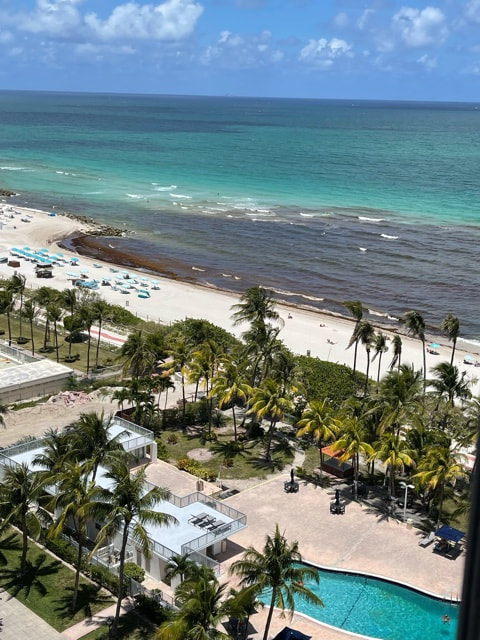
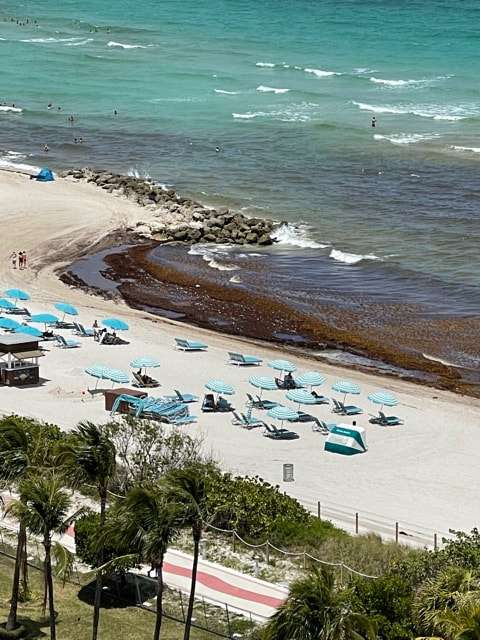
The "blanket" of Sargassum as seen between 27th and 29th Street: 
Picture
Picture
Picture
MIAMI BEACH SITE WITH INFO ON SEAWEEDS, SEA TURTLES & MORE
USF WATCH on Sargassum BLOOMS IN CARIBBEAN SeA
Picture
April, 2021:

Email: [email protected]

Midbeach neighborhood association, inc.